
 Search
Design Architecture and Operating Principle
The VQ series vane pump is a positive displacement hydraulic pump characterized by its balanced vane design, which distinguishes it from unbalanced vane pumps commonly found in lower-pressure applications. The pump's architecture centers around a slotted rotor mounted eccentrically within a cam ring, with vanes that slide radially in and out of the rotor slots as the rotor turns. This design configuration enables the VQ series to achieve operating pressures typically ranging from 140 to 210 bar (2,000 to 3,000 psi), making it suitable for industrial machinery, injection molding equipment, and mobile hydraulic systems.
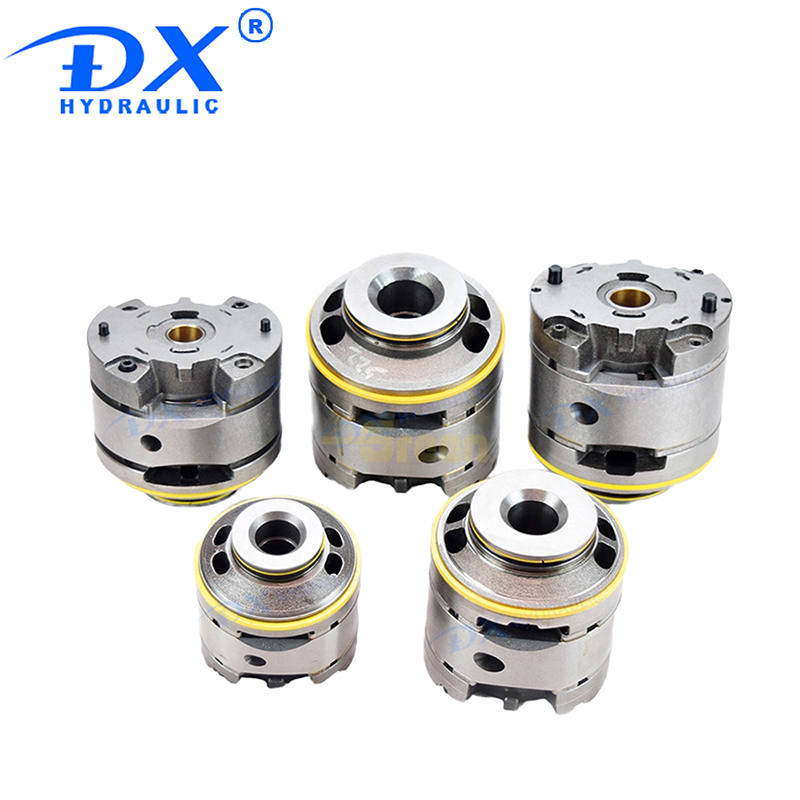
The operating principle of the VQ series relies on the volumetric change created by the eccentric relationship between the rotor and the cam ring. As the rotor rotates, centrifugal force and hydraulic pressure behind the vanes push them outward against the cam ring's inner surface. The cam ring's elliptical or contoured shape creates chambers that expand on the inlet side, drawing fluid into the pump through inlet ports, and contract on the outlet side, expelling fluid under pressure through outlet ports. Unlike unbalanced vane pumps where all pressure acts on one side of the rotor, the VQ series features two inlet and two outlet ports arranged symmetrically around the rotor. This balanced configuration cancels radial hydraulic forces on the rotor, significantly reducing bearing loads and extending service life.
The VQ series encompasses multiple frame sizes—commonly VQ15, VQ25, VQ35, and VQ45—each corresponding to a range of displacements. Within each frame size, different cam ring profiles provide discrete displacement options, typically ranging from 5 to 70 cubic centimeters per revolution depending on the series. This modular design allows manufacturers to select the appropriate displacement for specific applications while maintaining common mounting interfaces and port configurations.
Hydraulic Performance Characteristics
The VQ series vane pump delivers specific performance characteristics that determine its suitability for various hydraulic applications. Displacement, pressure capability, speed range, and volumetric efficiency form the core performance parameters that users evaluate when selecting a pump for a given system.
Displacement in the VQ series ranges from approximately 5 cm³/rev to 70 cm³/rev across the product family, with the specific displacement determined by the cam ring profile. Larger displacement models produce higher flow rates at given rotational speeds, making them suitable for applications requiring rapid actuator movement. Conversely, smaller displacement models provide finer flow control, often preferred in precision hydraulic circuits. The relationship between displacement, rotational speed, and flow output follows the formula: Flow (L/min) = Displacement (cm³/rev) × Speed (rpm) × Volumetric Efficiency / 1000.
Pressure capability distinguishes the VQ series from lower-cost vane pump alternatives. Standard VQ pumps are rated for continuous operation at 140 bar (2,000 psi), with intermittent operation permitted up to 175 to 210 bar (2,500 to 3,000 psi) depending on the specific model and displacement. This pressure capability positions the VQ series between gear pumps—typically limited to 210 bar but with lower efficiency at higher pressures—and piston pumps that operate at higher pressures but with greater complexity and cost. The balanced vane design maintains volumetric efficiency between 85 and 95 percent across of the operating range, with efficiency decreasing at lower speeds due to leakage through internal clearances.
Construction Materials and Sealing Systems
The VQ series vane pump incorporates materials selected to withstand the mechanical loads, hydraulic pressures, and fluid compatibility requirements of industrial hydraulic systems. The pump's construction reflects a balance between strength, wear resistance, and manufacturing precision.
Major components and materials:
Pump housing: Typically manufactured from high-grade cast iron (such as FC250 or equivalent), the housing provides structural rigidity and contains the internal cartridge assembly. Cast iron offers damping characteristics that contribute to noise reduction and maintains dimensional stability across the pump's operating temperature range of -20°C to 80°C for standard versions. Housing porting is machined with surface finishes of 1.6 micrometers Ra or better to ensure sealing integrity.
Rotor: Produced from carburized or induction-hardened steel, the rotor achieves surface hardness of 58 to 62 HRC on its outer diameter and vane slot surfaces. The rotor's thickness—typically 20 to 60 millimeters depending on displacement—determines the width of the pumping chambers. Rotor slots are broached or wire-EDM machined to maintain parallel within 0.005 millimeters across the slot length.
Vanes: The vanes represent the component subject to wear. Standard VQ series use vanes manufactured from tool steel (such as SKD11 or equivalent) with surface hardness of 60 to 64 HRC. The vane edges are radiused to 0.1 to 0.3 millimeters to maintain continuous contact with the cam ring while stress concentrations. Advanced versions utilize vanes with diamond-like carbon (DLC) coatings or solid ceramic vanes for extended life in applications with contaminated fluid or extended operating hours.
Cam ring: Produced from through-hardened alloy steel, the cam ring's internal profile is precision ground to maintain surface finishes of 0.4 micrometers Ra or better. The cam ring's eccentricity and profile geometry determine the pump's displacement and flow ripple characteristics. Cam rings are classified by displacement within each frame size, with key identification features preventing incorrect assembly.
