 Search
Replacing a hydraulic pump often looks straightforward: remove the worn unit, find another pump with a similar appearance, and install it. Hydraulic vane pumps, however, require a closer specification check. Two pumps may have similar housings while differing in displacement, shaft configuration, rotation direction, port arrangement, or pressure capability.
This makes the question more useful than simply asking whether a replacement pump needs to look the same. A suitable Replacement Hydraulic Vane Pump needs to match the hydraulic and mechanical requirements of the existing system. Some dimensions may need to remain identical for a direct installation, while other specifications can sometimes vary when the hydraulic circuit has been deliberately redesigned.
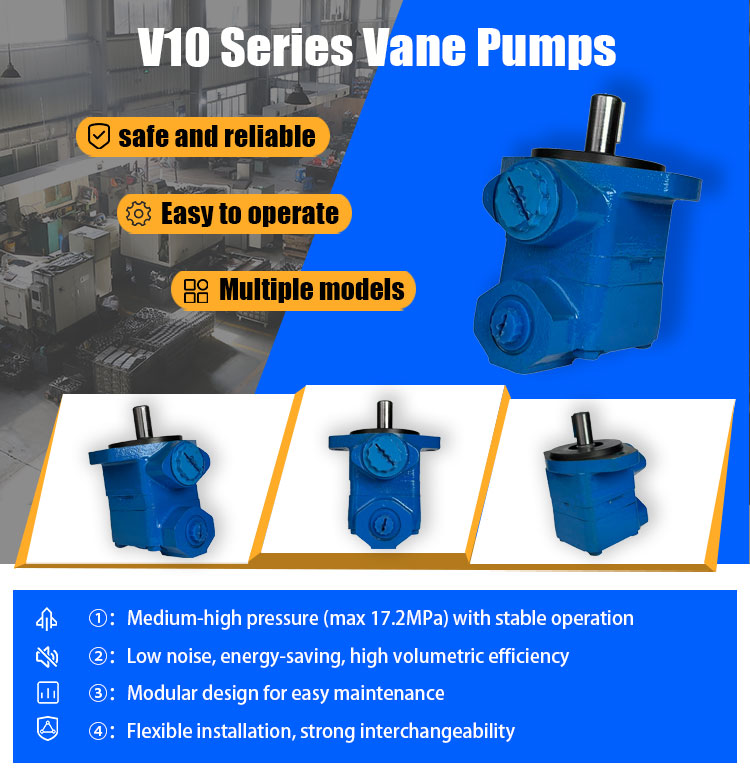
Why Appearance Is Not Enough
A hydraulic vane pump converts mechanical rotation into hydraulic flow through a rotor, vanes, cam ring, and pressure plates. Its external housing provides the mounting interface, but the internal pumping geometry determines displacement and hydraulic performance.
A replacement that looks almost identical can still produce a different amount of oil per revolution. That difference can affect cylinder speed, hydraulic motor speed, pressure behavior, and the overall operating cycle of the machine.
- Similar housing: Does not automatically mean equal displacement.
- Same shaft diameter: Does not confirm the correct spline or key arrangement.
- Same pressure rating: Does not guarantee compatible mounting or port dimensions.
- Same brand family: Does not guarantee that every model is interchangeable.
Current replacement-pump guides commonly identify displacement, pressure rating, shaft, ports, rotation, and mounting flange as key cross-reference parameters.
Which Specifications Actually Need to Match?
A replacement project becomes easier when the pump specifications are separated into two groups: hydraulic performance and physical compatibility.
| Specification | What It Controls | Replacement Concern |
| Displacement | Flow per revolution | Different value can change actuator speed |
| Pressure rating | Allowable hydraulic load | Must meet system operating pressure |
| Rotation | Correct pumping direction | Must correspond with the drive system |
| Shaft | Mechanical power transmission | Spline, key, diameter, and length matter |
| Mounting | Physical installation | Flange, bolt pattern, and dimensions must align |
| Ports | Hydraulic connections | Thread type, size, and position affect installation |
| Speed range | Operating RPM | Must suit the prime mover |
Displacement Is More Than a Number on the Datasheet
Pump displacement is normally expressed as cm³/rev, cc/rev, or cubic inches per revolution. It represents the theoretical volume moved during each shaft revolution.
A simplified flow relationship is:
Flow ≈ Displacement × RPM × Volumetric Efficiency
Suppose an existing pump has a displacement of 32.8 cm³/rev and operates at 1,200 rpm. A replacement with the same displacement will generally preserve a similar theoretical flow under comparable operating conditions. A published V20 replacement example lists 32.8 cm³/rev, a 1,200 rpm rated speed, and a 2,800 rpm max speed.
A different displacement changes the hydraulic output even though the pump may physically fit the same mounting position. That can alter cylinder travel time or hydraulic motor speed.
Can a Larger Displacement Be Used?
Sometimes, but it should not be treated as a simple upgrade. A larger displacement produces more theoretical flow at the same RPM, but it also requires greater input torque under a given pressure.
A machine originally designed around a particular pump size may therefore experience increased drive demand after installing a larger-displacement replacement. The hydraulic circuit, prime mover, relief setting, and actuator requirements should all be reviewed before making such a change.
Pressure Rating Does Not Tell the Whole Story
Pressure is another specification that requires careful interpretation. A pump may have a max pressure rating, a continuous working pressure, and sometimes an intermittent or peak pressure rating.
These values should not be treated as interchangeable.
- Continuous pressure: The pressure associated with sustained operation within the manufacturer's rating.
- Intermittent pressure: A higher pressure that may be permitted for limited operating periods.
- Maximum pressure: A specified upper boundary that should not automatically be interpreted as a continuous operating target.
For example, a current V20 vane-pump listing specifies a 2,500 psi max pressure together with a 3,000 rpm speed rating. Other models within the same general family can have different displacement and speed specifications.
Rotation Direction Can Stop a Replacement Before It Starts
Rotation is easy to overlook because it may not be obvious from the outside. Hydraulic vane pumps can be designed for clockwise or counterclockwise operation, and the specification is generally referenced from the shaft end.
A replacement with the wrong rotation may not establish the intended inlet and outlet flow path. Parker service documentation also distinguishes between bi-rotational and uni-rotational configurations and describes different procedures depending on the port-plate design.
Before ordering a Replacement Hydraulic Vane Pump, confirm the existing pump's rotation from its identification information or manufacturer documentation rather than relying on the position of the ports alone.
The Shaft Is a Mechanical Compatibility Check
The hydraulic circuit may be perfectly matched while the pump still cannot be installed because the shaft does not match the drive coupling.
Common details include:
- Shaft diameter
- Keyed or splined configuration
- Spline tooth count
- Shaft length
- Shaft-end geometry
- Seal and bearing arrangement
One published V20 replacement model, for example, uses a 13-tooth SAE B splined shaft, while another listed model uses a 3/4-inch straight shaft with key. Both are vane pumps, but their mechanical interfaces are clearly different.
Mounting Dimensions Can Decide a Direct Swap
A direct replacement is particularly attractive because it can avoid changes to the machine frame and hydraulic piping. The mounting flange therefore becomes an important part of the cross-reference process.
Check:
- Flange standard
- Number of mounting bolts
- Bolt-circle dimensions
- Pilot diameter
- Pump body dimensions
- Port position relative to the mounting face
Replacement Vickers-pattern pumps demonstrate why these details matter. Published models can share an SAE A two-bolt mounting arrangement while differing in displacement, shaft, rotation, and port configuration.
Do the Hydraulic Ports Need to Be Identical?
Port compatibility is another area where a visually similar pump can create installation problems. Thread type, port size, port orientation, and inlet/outlet position can all affect whether existing hoses can be reused.
A replacement may have the correct displacement and pressure rating but still require an adapter or modified hose arrangement because the port configuration differs.
This does not necessarily make the pump unsuitable. It simply means the replacement is no longer a straightforward mechanical swap and should be evaluated as a broader installation project.
Single Pump or Double Pump?
Configuration also matters. A single vane pump has one pumping section, while a double or tandem pump combines two sections on a common drive shaft.
Replacing a double pump with a single pump changes the hydraulic architecture unless the circuit has been redesigned accordingly. The same principle applies in reverse: installing a double pump where a machine originally used a single pump does not automatically provide a useful improvement.
Published Vickers service information describes single and double pump configurations and cartridge arrangements with different displacement combinations.
Can an Obsolete Pump Have a Modern Replacement?
Yes, an obsolete model does not necessarily mean the entire hydraulic system needs to be redesigned. Cross-reference methods can identify a current pump based on the technical characteristics of the original unit.
Modern replacement ranges often use frame size, displacement code, shaft arrangement, mounting interface, rotation, and port configuration to identify compatible alternatives. Some suppliers specifically provide cross-reference services for discontinued Vickers, Eaton, Parker, and related vane-pump models.
What Information Should Buyers Provide?
A clear replacement inquiry should include as much information as possible:
- Original pump model number
- Displacement or rated flow
- Operating and max pressure
- Clockwise or counterclockwise rotation
- Shaft type and dimensions
- Mounting flange details
- Inlet and outlet port specifications
- Operating speed
- Single, double, or multiple-pump configuration
A photograph of the pump nameplate can also help identify an obsolete model, although technical dimensions should still be verified before placing an order.
Replacement vs. Rebuilding the Existing Pump
Buying a complete Replacement Hydraulic Vane Pump is not the only option. Some vane pumps use replaceable cartridges, allowing the worn pumping components to be replaced while the original housing remains in service.
A cartridge-based solution may make sense where the housing, shaft, and mounting components remain serviceable. A complete replacement becomes more appropriate where the housing, shaft, bearings, or other major components have suffered damage.
The decision should therefore consider both the condition of the existing pump and the availability of compatible replacement components. Vane-pump component suppliers commonly match cartridge kits according to displacement, pressure, rotation, mount, and shaft configuration.
A Practical Replacement Checklist
| Check | Question to Ask |
| Flow | Does the displacement provide the required flow at the actual RPM? |
| Pressure | Can the replacement support continuous and intermittent system pressure? |
| Rotation | Does the shaft rotate in the required direction? |
| Shaft | Will the existing coupling or drive fit? |
| Mount | Will the pump bolt directly onto the machine? |
| Ports | Can existing hydraulic lines connect correctly? |
| Speed | Is the operating RPM within the pump's rated range? |
| Configuration | Is it a single, double, or another multi-section arrangement? |
The Same Specifications Are Not Always Necessary
The answer to the title question is therefore slightly more nuanced than a simple yes or no. A direct replacement normally needs to reproduce the critical hydraulic and mechanical specifications of the original pump. However, a redesigned system can use different specifications when the engineer has also accounted for the changes in flow, pressure, power, mounting, piping, and control requirements.
For a straightforward replacement, keeping the original displacement, pressure capability, rotation, shaft configuration, mounting interface, port arrangement, and operating speed within the required range provides a much safer starting point.
Final Takeaway
A Replacement Hydraulic Vane Pump should not be selected simply because it resembles the old unit. The real compatibility check involves both hydraulic performance and physical interfaces.
Displacement affects flow, pressure rating defines the allowable operating range, rotation determines pumping direction, while the shaft and mounting dimensions determine whether the pump can physically connect to the machine. Port configuration and operating speed complete the picture.
For equipment owners, distributors, and hydraulic-system buyers, the practical approach is to record the original pump's complete specification before searching for a replacement. A reliable cross-reference is built from several matching parameters rather than a part number or external appearance alone.
